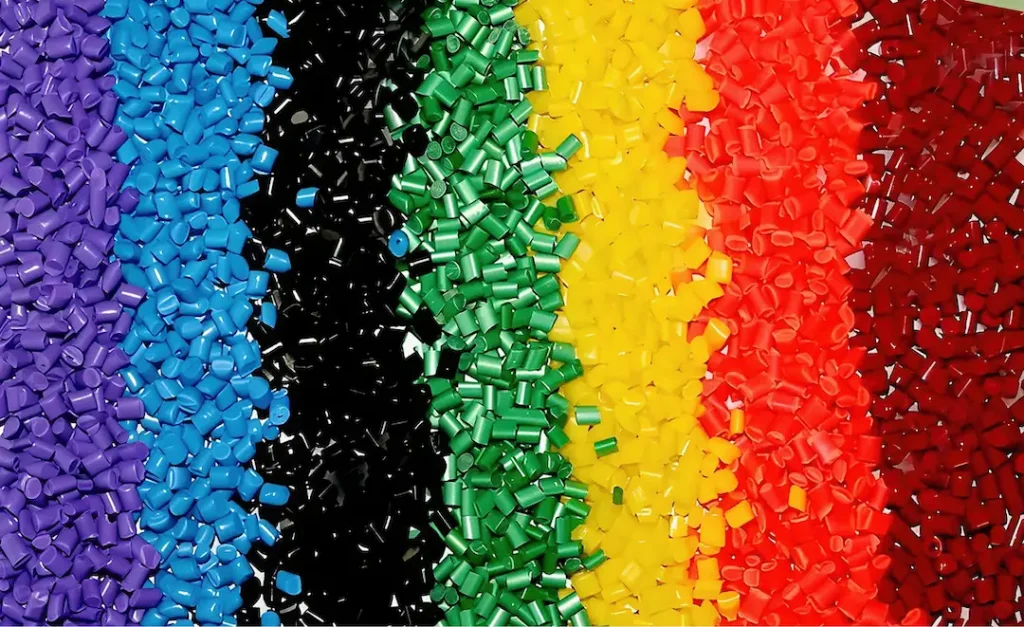
Functional fiber masterbatch puts color and performance into synthetic fiber at the melt stage, before the filament leaves the spinneret. Able Materials is a functional fiber masterbatch manufacturer in China, developing PET and PA6/PA66 grades for filament yarn, staple fiber, carpet fiber and nonwoven. Each grade is formulated around your polymer, spinning line and end-use standard, and it sits within our wider range of custom masterbatch products.
Selecting the right fiber masterbatch requires understanding its working principles, available carriers and functions, end-use requirements, and the process used to develop and release a custom grade.
What Functional Fiber Masterbatch Does
Dope dyeing and solution dyeing vs piece dyeing
In dope dyeing, also called solution dyeing or spin dyeing, pigment is dispersed in a carrier resin and metered into the polymer melt ahead of the spin pack. The fiber comes out already colored through its full cross-section.
Piece dyeing and package dyeing color the yarn or fabric afterward in a hot dye bath. That adds water, energy, chemical auxiliaries and wastewater treatment, and the dye sits mainly in the outer layer of the fiber.
| Dope dyeing (masterbatch) | Piece / package dyeing | |
|---|---|---|
| When color is added | In the melt, before fiber forms | After yarn or fabric is made |
| Colorant | Heat-stable pigment in a carrier | Disperse or acid dyes in a bath |
| Color location | Through the whole fiber | Mainly near the surface |
| Water use in coloring | Close to none | High |
| Color decision | Made early, at spinning | Made late, at dyeing |
The trade-off is flexibility. Because color is fixed at spinning, the shade must be approved before production starts.
Functional modification during melt spinning
The same metering point that adds color can add function. Additives for antibacterial, flame-retardant, UV, antistatic or cooling performance are compounded into the masterbatch and distributed evenly through the fiber. This avoids a separate finishing step and keeps the function inside the polymer rather than in a surface coating that can wear or wash off.
Color fastness, lightfastness and process stability
Pigment locked inside the polymer gives strong wash, rub and light fastness, which is why dope-dyed fiber is common in automotive, outdoor and contract textiles. Process stability matters just as much as color. Pigment and additives must survive PET spinning temperatures, stay finely dispersed and not clog spin-pack filters or cause filament breaks at your line speed.
Supported Carrier Polymers
The carrier resin must match the fiber polymer so that the masterbatch melts, flows and mixes evenly.
Polyester (PET) — filament yarn, staple fiber, nonwoven
PET carriers are used for POY, FDY and DTY filament, polyester staple fiber, and spunbond or needle-punched nonwoven. Grades are developed for chip spinning and direct melt spinning lines, including lines running recycled PET content. Detailed PET grade selection is covered on our polyester fiber masterbatch page.
Nylon (PA6 and PA66) — industrial yarn, textiles, carpets
PA6 and PA66 carriers are used for carpet and BCF yarn, industrial yarn, monofilament and textile filament. PA6 and PA66 differ in melt temperature and moisture behavior, so the carrier is matched to the exact grade. Grade details are covered on our nylon fiber masterbatch page.
Other carriers available on project review
PBT, PP and other fiber polymers can be reviewed case by case. Send the resin grade and spinning method, and we confirm whether a suitable carrier and pigment system can be developed before sampling.
Functional Capabilities for Synthetic Fibers
Each function is developed and tested per project. Performance depends on fiber type, denier, dosage and test method, so targets are agreed in writing before sampling.
Antibacterial / antimicrobial fiber masterbatch
Antibacterial grades build an antimicrobial additive into PET or PA fiber for textiles, hygiene products and home textiles. Performance is tested to the method your market uses, such as AATCC 100, ISO 20743 or GB/T 20944.3. In the United States, antimicrobial claims on treated articles fall under EPA rules, so claim wording is reviewed for each project.
Flame-retardant fiber masterbatch (including halogen-free options)
Flame-retardant grades are used in automotive interior textiles, curtains, upholstery and technical fabrics. Halogen-free options are available where the end market restricts halogenated chemistry. Target standards, such as FMVSS 302 or ISO 3795 for automotive interiors, are confirmed before formulation, and test results are tied to your fabric construction.
UV and weather-resistant fiber masterbatch
UV-stabilized grades protect color and fiber strength in outdoor fabrics, awnings, artificial turf and marine textiles. Lightfastness and weathering targets are set against methods such as AATCC 16.3 or ISO 105-B02.
Antistatic and conductive fiber masterbatch
Antistatic grades reduce static build-up in carpet yarn, workwear and filtration media. Conductive grades are used where a defined surface or volume resistance is required. The target resistance and test method are agreed per project.
Cooling, far-infrared and heat-retaining masterbatch
Cooling grades are used in sportswear and bedding to give a cooler touch, measured with methods such as GB/T 35263 or JIS L 1927 (q-max). Far-infrared and heat-retaining grades are used in thermal apparel and home textiles.
Photochromic and glow-in-the-dark masterbatch
Photochromic grades change color under UV light, and glow-in-the-dark grades store light and emit it in low light. Both are used in fashion, safety and novelty textiles. Suitability depends on polymer, denier and spinning temperature, so they are reviewed before sampling.
Applications and End-Products
Fiber masterbatch is chosen by end use as much as by polymer. More industry detail is available on our applications page.
Automotive interior textiles and automotive carpets
Seat fabrics, headliners, door trims and tufted carpets need high lightfastness, consistent color across batches and, in many programs, flame performance. OEM color references and documentation requirements are reviewed at the start of each project.
Outdoor and performance textiles
Outdoor furniture fabric, awnings, tents, sportswear and workwear combine UV stability with colorfastness, often with antibacterial or cooling function added in the same masterbatch.
Technical and industrial yarns
Industrial filament, sewing thread, webbing, ropes and monofilament need color without losing tenacity. Pigment loading and dispersion are set to protect mechanical properties.
Nonwoven fabrics for hygiene, medical and filtration
Spunbond and staple-fiber nonwovens use masterbatch for color, softness, antibacterial function or stiffness in filtration media. Hygiene and medical uses carry extra regulatory requirements, which are scoped per project.
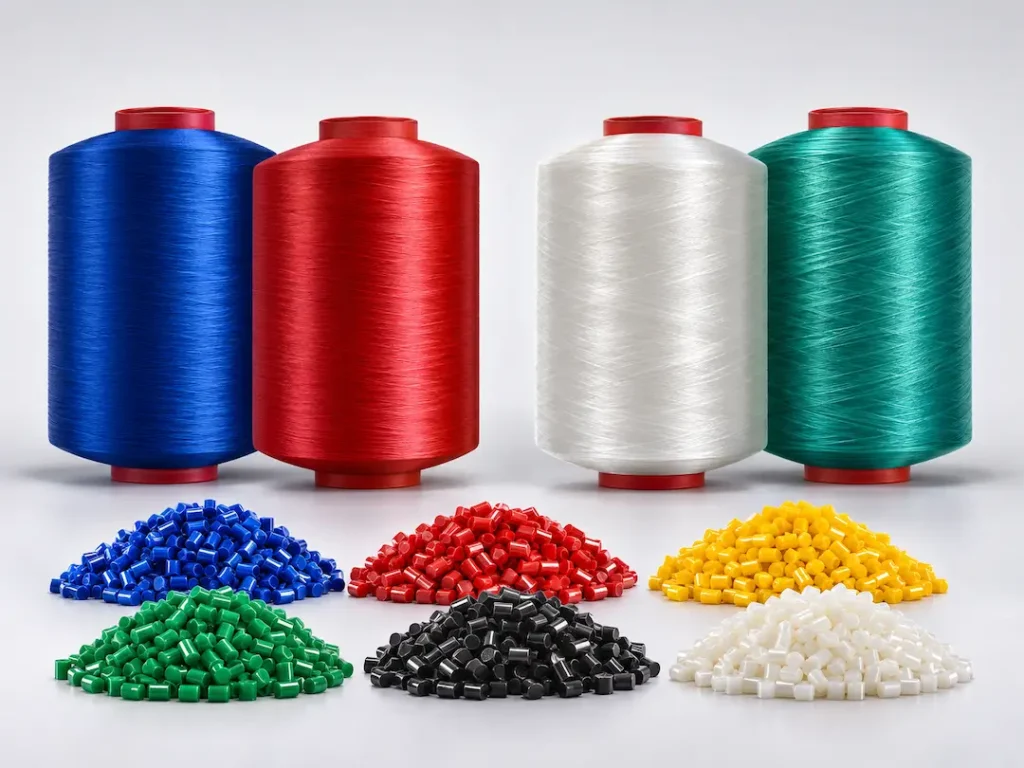
How Custom Fiber Masterbatch Is Developed
As a custom fiber masterbatch supplier in China, Able Materials develops each grade at our Suzhou base. Development runs in three steps.
Target yarn specification and spinning conditions
We start with the fiber, not the masterbatch:
- Polymer type and grade, including any recycled content
- Spinning process (chip or direct spinning, POY, FDY, staple, BCF or spunbond)
- Denier, filament count and cross-section
- Spinning temperature, throughput and filter mesh
- Target color reference and required function
- Applicable test standards and pass levels
Pigment or additive selection and let-down ratio
Pigments and additives are selected for heat stability at your spinning temperature, dispersion quality and fastness. The let-down ratio is set by shade depth, additive loading and the dosing range your feeders can hold accurately. The carrier is matched to your base resin’s melt flow so the masterbatch mixes evenly.
Pilot spinning validation and QC
A lab sample of 5–25 kg is checked for color, dispersion and melt behavior. Where needed, it is spun on a pilot melt-spinning line before a trial order of typically 100–500 kg runs on your own line. Once the trial is approved, the formulation and process settings are locked as the production reference. Production MOQ is typically 500–1,000 kg, depending on carrier resin and formulation.
Technical Documentation and Quality Control
Each batch is released against the approved reference. Our quality page explains the documents and checks we apply.
TDS, SDS and COA scope
- TDS: carrier, recommended let-down ratio, processing window and storage guidance
- SDS: hazard, handling and transport information for import
- COA per batch: color difference against standard, moisture, melt flow and dispersion results
Composition declarations and third-party test reports are provided where the application calls for them.
Color fastness, lightfastness and testing references
Fastness is evaluated on fiber or fabric made with the masterbatch, not on pellets alone. Commonly referenced methods include ISO 105-B02 and AATCC 16.3 for lightfastness, ISO 105-C06 for washing and ISO 105-X12 for rubbing. Functional performance uses the standard agreed for that function. Results apply to the tested construction and are confirmed for each project.
FAQ
How much masterbatch is added during fiber spinning?
Color fiber masterbatch is typically let down at about 1–5% by weight, depending on shade depth and pigment loading. Some black or white grades and functional additives run at different levels. The final ratio is confirmed in a spinning trial, not set from a table.
Does fiber masterbatch need drying before PET spinning?
Yes, in most cases. PET masterbatch absorbs moisture during storage, and moisture in the melt lowers viscosity and can cause filament breaks. Sealed packaging reduces pickup, but opened material should be dried to the same moisture level as your PET chip before use.
Can fiber masterbatch be used with recycled PET (rPET)?
Yes. Recycled PET varies more in color and intrinsic viscosity than virgin chip, so the carrier, pigment system and dosage should be validated on your actual rPET feed. Shade correction is often needed when the recycled content or source changes.
What is filter pressure value (FPV), and why does it matter?
Filter pressure value measures how fast pressure rises when molten masterbatch is pushed through a fine screen. It shows how well the pigment is dispersed. A low value reduces spin-pack pressure rise, filter changes and filament breaks, which matters most for fine-denier yarn. Many fiber producers set a maximum FPV in their purchase specification.
Is dope-dyed fiber practical for small runs or frequent color changes?
It is less flexible than piece dyeing because each color is fixed at spinning and every color change needs a line purge. It suits repeat colors and stable programs best. Trial quantities of 100–500 kg make it possible to qualify a new shade before committing to production volume.
Request a Functional Fiber Masterbatch Quote
To quote a functional fiber masterbatch project, send us:
- Fiber polymer and grade (PET, PA6, PA66 or other), including recycled content
- Spinning process, denier and filament count
- Target color (Pantone, RAL or physical sample) and/or required function
- Test standards and pass levels
- Trial quantity and expected annual volume
- Destination country and required documents
Our technical team will review feasibility and propose a sampling route. Use our contact page to send your specification.