
Table of Contents
If your bill of materials calls for a high-integrity aluminum block that will be machined into a structural fitting, mold plate, or die base, the raw stock you choose decides everything downstream: fatigue life, machining distortion, scrap rate, and unit cost. This guide explains what a forged aluminum block is, why buyers source it from China, and how Able Materials in Suzhou, Jiangsu produces certified blocks for demanding OEM and ODM programs.
What Is a Forged Aluminum Block? (Definition & Manufacturing Overview)
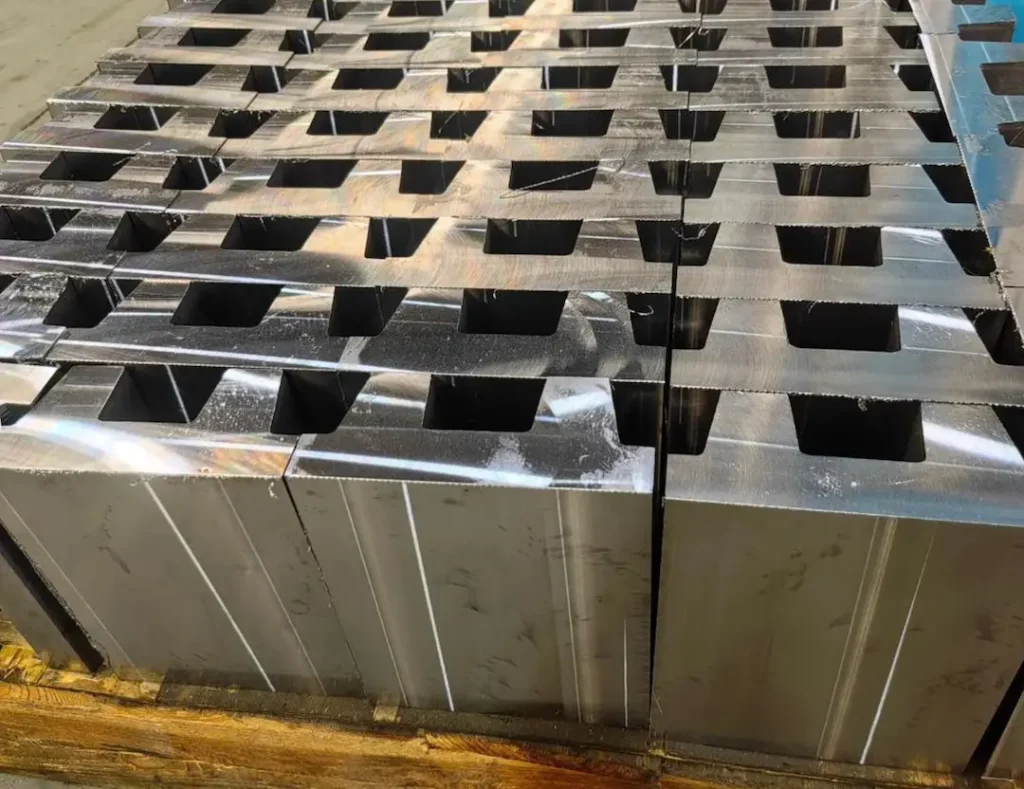
A forged aluminum block is a solid rectangular billet shaped under compressive load—open-die or closed-die—so the metal’s grain flows continuously around the geometry instead of being cut through, as it is in plate or bar. That distinction is the whole value proposition. As a core product within our Custom Aluminum Forging range, the aluminum forged block is engineered for parts that must carry load in more than one direction.
How Forged Blocks Differ from Cast and Rolled Aluminum Blocks
Cast blocks can contain porosity and shrinkage voids that show up as leak paths or fatigue initiation sites. Rolled plate has directional properties that are strong in the rolling direction but noticeably weaker through the thickness (the short-transverse, or ST, direction). A forged block closes internal voids under pressure and refines grain, delivering more uniform properties across all three axes—which is why forged aluminum blocks are specified where a machined part cannot tolerate a weak axis.
Why Forging Improves Grain Structure and Mechanical Strength
Grain Flow Orientation and Fatigue Resistance
In independent short-transverse fatigue testing, forged 7xxx sections typically show 10–20% longer fatigue life than rolled plate of the same alloy and temper, precisely because the grain flow is not interrupted by machining. For components cycling above 10⁷ loads—landing-gear fittings, suspension uprights—this margin is the difference between passing and failing qualification.
Forging Reduction Ratio Explained (3:1 Minimum Standard)
The reduction ratio is the measure of how much the starting billet is worked. We hold a minimum 3:1 reduction on structural blocks to guarantee grain refinement; higher-integrity aerospace work is forged to 4:1 or more. Below roughly 3:1, the metallurgical benefit over plate shrinks, and the premium is hard to justify.
Why Choose a Chinese Manufacturer for Forged Aluminum Blocks
China combines press capacity, alloy availability, and machining depth in a single supply base, which shortens the path from billet to finished part.
Cost Advantages of Aluminum Forging in China
Landed cost on China-sourced forged blocks typically runs 20–35% below Western equivalents on comparable specifications and volumes. The savings are driven by tooling amortization across larger runs, in-house heat treatment, and integrated CNC finishing—not by cutting metallurgical corners.
Production Capacity and Press Tonnage Comparison (5,000–10,000+ Ton Presses)
Press tonnage sets the maximum sound section you can forge. Facilities in our network operate presses from 1,600 tonnes up to 10,000+ tonnes, enabling block footprints up to roughly 3,000 × 1,500 mm and per-piece weights near 4,500 kg. Larger presses also allow a higher reduction ratio on thick sections, improving core soundness.
Export Experience and Global Shipping Logistics
Suzhou sits within 100 km of Shanghai’s Yangshan and Waigaoqiao ports, so ocean freight consolidation, export documentation, and EXW/FOB/CIF terms are routine rather than exceptional. Typical sea transit runs 25–40 days to North America and Europe.
Common Client Industries Sourcing from China
Aerospace tier suppliers, automotive tooling shops, mold makers, and defense subcontractors are the primary buyers—segments that value the pairing of forging metallurgy with the broader Custom Aluminum Forging catalog under one supplier.
Top Forged Aluminum Block Manufacturers in China (2026 Overview)
Choosing a supplier is a due-diligence exercise, not a price search. The right questions surface quickly, which factories can hold a specification.
How to Evaluate a Chinese Forging Supplier
Checking AS9100D, ISO 9001, and NADCAP Certifications
ISO 9001:2015 is the baseline; AS9100D signals aerospace-grade process control; NADCAP accreditation on heat treatment and NDT is non-negotiable for flight hardware. Ask for certificate numbers and expiry dates, then verify them against the issuing registrar.
Verifying Ultrasonic Testing Reports (AMS-STD-2154 Class A/B)
Internal soundness is proven by ultrasonic inspection. AMS-STD-2154 Class A permits no discontinuity larger than a 1.2 mm flat-bottom-hole equivalent—tighter than the 2.0 mm typical of standard plate acceptance. Confirm the class in writing before you order.
Requesting Material Test Certificates (MTC) and Traceability
Every lot should ship with an MTC listing chemistry, mechanical results (UTS, yield, elongation), temper, and heat/lot number traceable back to the ingot. Traceability is what makes a claim auditable.
Red Flags: How to Avoid Low-Quality or Uncertified Suppliers
Be wary of quotes far below the market band, refusal to share test data, generic “aluminum alloy” descriptions without an alloy-temper callout, and no in-house metallurgical lab. Any one of these correlates with downstream scrap.
Aluminum Alloys Used in Forged Blocks (6061, 7075, 2024, 2219)
Alloy selection is a trade-off between strength, toughness, weldability, and corrosion resistance. These are the four grades that cover the majority of block programs.
6061-T651 Forged Blocks — General Purpose, Weldable Grade
The workhorse. Typical properties: UTS ~310 MPa, 0.2% yield ~276 MPa, elongation ~12%, hardness ~95 HB, density 2.70 g/cm³, thermal conductivity 167 W/m·K, electrical conductivity 43% IACS. Weldable and corrosion-resistant—ideal for jigs, fixtures, and general structural blocks.
7075-T651 Forged Blocks — High-Strength Aerospace Grade
The strength leader. Typical properties: UTS ~570 MPa, 0.2% yield ~503 MPa, elongation ~11%, hardness ~150 HB, density 2.81 g/cm³, thermal conductivity 130 W/m·K, electrical conductivity 33% IACS. Not readily arc-weldable, but unmatched for highly stressed machined parts.
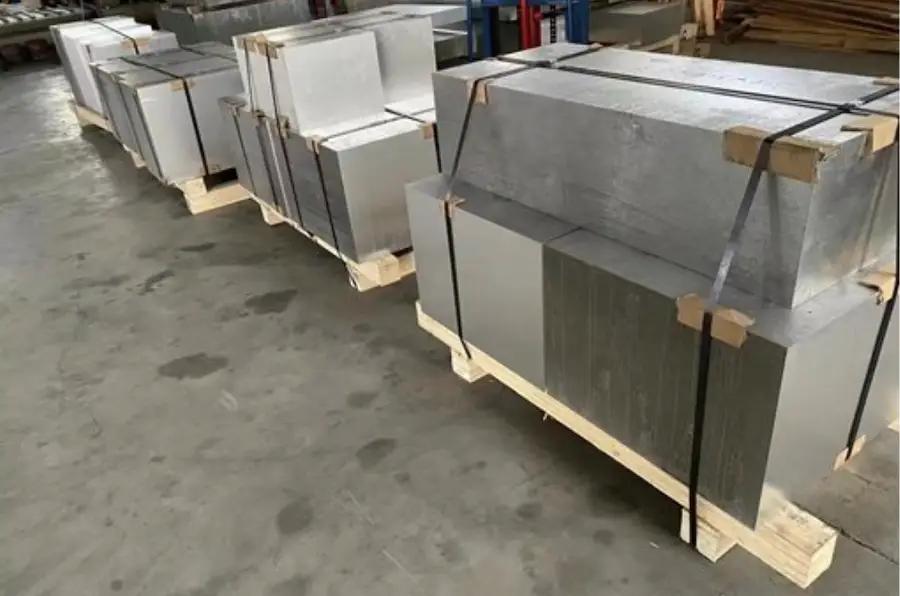
2024/2219 Forged Blocks — Fatigue-Resistant, High-Temperature Grade
2024-T351 offers the best fatigue resistance of the group (UTS ~470 MPa, yield ~325 MPa, elongation ~19%), while 2219 retains strength at elevated temperature—valuable for aerospace and defense components running warm. For very thick aerospace sections above 150 mm, 7050-T7451 adds stress-corrosion resistance with fracture toughness K₁c ≈ 35 MPa·√m (L-T).
Alloy Comparison Table: Tensile Strength, Hardness, Density, Conductivity
| Alloy-Temper | UTS (MPa) | Yield (MPa) | Elong. (%) | Hardness (HB) | Density (g/cm³) |
|---|---|---|---|---|---|
| 6061-T651 | 310 | 276 | 12 | 95 | 2.70 |
| 7075-T651 | 570 | 503 | 11 | 150 | 2.81 |
| 2024-T351 | 470 | 325 | 19 | 120 | 2.78 |
| 7050-T7451 | 525 | 469 | 10 | 140 | 2.83 |
The 4% density gap between 6061 and 7075 matters directly in aerospace buy-to-fly calculations—worth modeling before you commit to an alloy.
The Aluminum Forging Process Explained Step by Step
Understanding the route helps you write a specification that a factory can actually meet.
Open-Die Forging vs. Closed-Die Forging for Blocks
Open-die forging works the billet between flat or simple dies—flexible, low tooling cost, ideal for one-offs and larger blocks. Closed-die forging shapes metal in a cavity for near-net geometry and higher throughput, justified once volumes rise. The same logic that governs aluminum forged rings and aluminum forged discs applies to blocks: tooling cost is amortized against quantity.
Solution Heat Treatment, Quenching, and Artificial Aging (T6/T651)
A T6/T651 temper requires solution treatment (typically 465–540 °C depending on alloy), rapid quench, and controlled artificial aging. Electrical conductivity is then measured per AMS 2658 as an independent check that the heat-treat cycle achieved the target microstructure.
Stress Relief and Stretching for Dimensional Stability
The T651 condition adds 1.5–3% permanent stretch after quench, cutting residual stress by roughly 80% versus an unstretched T6. The payoff on the shop floor: post-machining distortion typically stays under 0.1 mm per 300 mm, so thin-walled parts stay flat.
CNC Machining and Surface Finishing of Forged Blanks
Blocks ship as-forged or machined. As-forged flatness runs ≤ 2 mm/m; fly-cut faces reach ≤ 0.4 mm/m, and precision-machined blocks hold ±0.13 mm. In-house CNC means the same supplier that forges your block can deliver it ready to finish.
Technical Specifications and Standards to Request
A tight specification is your best defense against ambiguity. Name the standards explicitly on the drawing and PO.
ASTM B247 and EN 586-2 Compliance
ASTM B247 governs aluminum die forgings and hand forgings; EN 586-2 covers mechanical property limits. Thickness tolerance under B247 is typically +4.8/−0 mm on a 200 mm section—call out a machined option if you need tighter.
AMS 4147 / AMS 4126 Aerospace Specifications
For flight and defense work, cite the AMS callout directly: AMS 4147 for 7075-T7452 forgings, AMS 4126 for 7075-T6, and AMS-A-22771 for general aluminum-alloy forgings. These fix chemistry, temper, and test acceptance in one reference.
Dimensional Tolerances, Flatness, and Ultrasonic Inspection Classes
Specify three things and most disputes disappear: dimensional tolerance band, flatness limit, and ultrasonic class (A, B, or C per AMS-STD-2154). Aerospace blocks should carry Class A.
Applications of Forged Aluminum Blocks
The block’s multi-directional strength makes it the default for parts machined from solid.
Aerospace Structural Fittings and Bulkheads
Highly loaded fittings, bulkhead segments, and wing hardware machined from 7075 or 7050 forgings, where short-transverse strength is safety-critical.
Automotive Tooling and Die Bases
Motorsport uprights, check fixtures, and die bases benefit from 6061 and 7075 blocks that machine cleanly and resist deflection.
Mold Plates and Injection Molding Tooling
Large 6061/7075 blocks serve as mold plates and bolster plates where flatness and thermal conductivity speed cycle times—often specified alongside aluminum forged bars and aluminum forged tubes on the same tooling BOM.
Military and Defense Components
Armor mounts, housings, and ground-support hardware in 2024/2219 and 7075, where traceability and certified test data are mandatory.
Custom Forged Aluminum Block Manufacturing: What to Provide Your Supplier
A complete data package on day one compresses lead time and eliminates re-quoting.
Drawing, Alloy, and Temper Requirements Checklist
Send a dimensioned drawing (or STEP file), the exact alloy-temper (e.g., 7075-T651), required standard, ultrasonic class, and surface condition (as-forged vs. machined). Ambiguity here is the number-one cause of delay.
MOQ, Lead Time, and Pricing Factors for China-Sourced Forgings
Price is driven by alloy grade, block volume and weight, reduction ratio, heat-treat and NDT requirements, and quantity—not by any single fixed rate. Prototype quantities are accepted; unit cost falls sharply as volume amortizes tooling and setup. Standard lead times run 4–8 weeks depending on section size and certification depth.
Sample Approval and First-Article Inspection (FAI) Process
For new programs, we provide a first article with a full dimensional report and MTC before series release, so your quality team signs off against evidence, not promises.
Frequently Asked Questions About Sourcing Forged Aluminum Blocks from China
What Is the Lead Time for Custom Forged Aluminum Blocks?
Typically 4–8 weeks from approved drawing, depending on section size, alloy availability, and whether aerospace-level NDT and certification are required.
Can Chinese Manufacturers Supply Aerospace-Grade (AMS) Forgings?
Yes. With AS9100D systems, NADCAP-accredited heat treatment and NDT, and AMS-STD-2154 Class A ultrasonic inspection, aerospace-grade forgings are produced and shipped with full traceability.
What Is the Minimum Order Quantity for Forged Blocks?
Open-die forging supports low quantities, including single prototypes. Closed-die work becomes economical at higher volumes where tooling cost is spread across the run.
How Is Quality Verified Before Shipment?
Each lot ships with a Material Test Certificate, ultrasonic and dimensional reports, and heat/lot traceability—supported by first-article inspection on new parts.
Able Materials manufactures custom forged aluminum rings, blocks, bars, tubes, discs, and finished parts from Suzhou, Jiangsu, China. Send your drawing and alloy-temper requirement for a factory-direct quote with lead time and certification scope.