
Table of Contents
Custom Aluminum Forging Manufacturer in China
Sourcing forged aluminum components that meet exact mechanical and dimensional specifications is a demanding task for any procurement or engineering team. Based in Suzhou, Jiangsu—one of China’s largest and most advanced industrial cities—Able Materials manufactures Custom Aluminum Forging rings, blocks, bars, tubes, discs, and finished parts for B2B buyers worldwide. This guide walks through our processes, alloys, capabilities, and quality systems so you can specify and source with confidence.
What Is Custom Aluminum Forging?
Custom aluminum forging is a metal-forming process in which heated aluminum billet is shaped under compressive force using dies or presses. The result is a near-net-shape component with a continuous, deformed grain structure that follows the contour of the part—delivering strength and reliability that other manufacturing methods struggle to match.
How Forging Differs from Casting and Machining
Casting pours molten metal into a mould, which can leave porosity and shrinkage defects. Machining removes material from solid stock, wasting material and cutting through the grain flow. Forging refines the internal grain and eliminates voids, producing parts with typically 20–30% higher fatigue life and superior structural integrity. For load-bearing and safety-critical applications, forged aluminum is the dependable choice.
Why Manufacturers Choose Aluminum Over Steel or Titanium
Aluminum offers an excellent strength-to-weight ratio at roughly 2.70 g/cm³—about one-third the density of steel. It resists corrosion naturally, conducts heat and electricity well, and machines easily in secondary operations. Compared with titanium, it is far more cost-effective while still delivering the performance most structural and rotational components require.
Custom Aluminum Forging Processes We Offer
Different geometries and volumes call for different forging methods. As a full-capability manufacturer, we match each project to the most efficient and economical process.
Closed-Die Forging for High-Volume Precision Parts
Closed-die (impression-die) forging presses billet between shaped dies to form complex geometries, holding tolerances of ±0.25–0.75 mm on parts from 0.05 kg to 150 kg. It is ideal for repeatable, high-volume production where consistency matters. Our forged aluminum block products—supplied as aluminum forged blocks—are frequently produced this way for mould bases, structural fittings, and machining stock.
Precision Net-Shape Forging (±0.13 mm Tolerance)
For components that require minimal secondary machining, precision net-shape forging achieves tolerances as tight as ±0.13 mm with machining stock of 0.5 mm or less per side. This reduces material waste and downstream costs—an advantage for buyers managing tight budgets and delivery schedules.
Open-Die Forging for Large, Low-Volume Components
Open-die forging shapes billet between flat or simple contoured dies, making it well suited to large or low-volume parts weighing from 5 kg up to 1,500 kg. Because it requires no dedicated tooling, it is the cost-effective route for prototypes and heavy sections. Our aluminum forged bars are commonly produced through open-die methods for shafts, spindles, and structural stock.
Rolled Ring Forging for Seamless Rings up to 2,500 mm OD
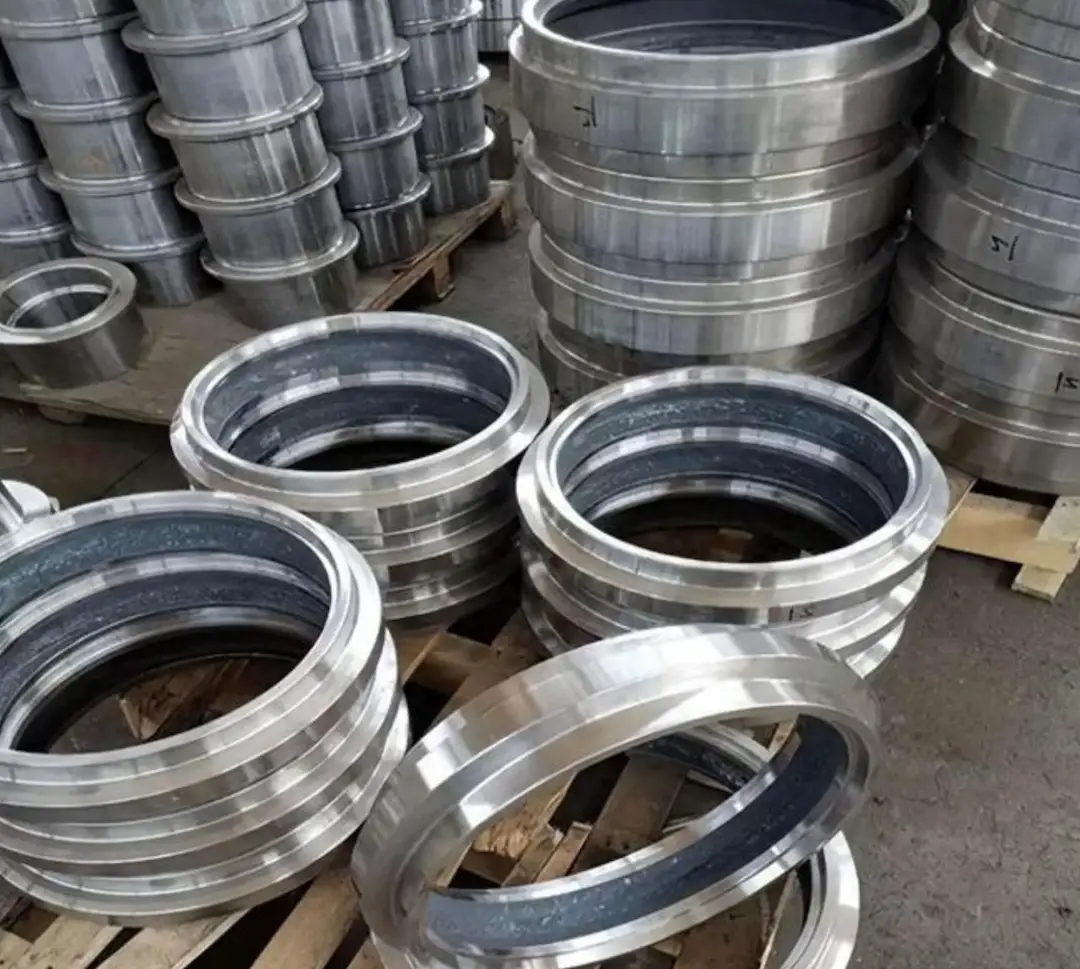
Rolled ring forging expands a pierced billet on a radial–axial mill to create seamless rings with outer diameters up to 2,500 mm. The circumferential grain flow gives outstanding hoop strength. Our aluminum forged rings serve bearings, flanges, gears, and rotating assemblies where seamless integrity is essential.
Cold Forging for Small, High-Tolerance Parts
Cold forging shapes aluminum at room temperature, achieving tolerances near ±0.05 mm with excellent surface finish and work-hardened strength. It suits small, high-volume parts such as fasteners and connectors where precision and throughput are priorities.
Aluminum Alloys We Forge
Alloy selection directly determines the strength, corrosion resistance, and machinability of the finished part. We forge the full range of common structural and aerospace grades.
6061 & 6082 Aluminum Forgings (General Structural Use)
The 6xxx series (Al–Mg–Si) offers the best forgeability, good corrosion resistance, and reliable weldability. 6061-T6 delivers around 310 MPa ultimate tensile strength and 276 MPa yield—ideal for general structural, marine, and automotive applications. 6082 is the common European structural equivalent.
7075 & 7050 Aluminum Forgings (High-Strength Aerospace Grade)
The 7xxx series (Al–Zn) provides the highest strength. 7075-T6 reaches roughly 572 MPa tensile and 503 MPa yield, while 7050-T7452 balances strength with stress-corrosion resistance for thick airframe sections. These grades are the standard for demanding aerospace and defense structures.
2014 & 2618 Aluminum Forgings (Elevated-Temperature Applications)
The 2xxx series (Al–Cu) performs well under elevated temperatures. 2014-T6 is used in aircraft fittings and heavy truck frames, while 2618 is favored for pistons and components operating in hotter service environments.
Alloy Comparison Table: Tensile Strength, Yield, and Forgeability
| Alloy–Temper | UTS (MPa) | Yield (MPa) | Elongation (%) | Typical Use |
|---|---|---|---|---|
| 6061-T6 | 310 | 276 | 12 | General structural, marine |
| 6082-T6 | 310 | 260 | 10 | EU structural equivalent |
| 7075-T6 | 572 | 503 | 11 | High-strength airframe |
| 7050-T7452 | 510 | 441 | 11 | Thick-section airframe |
| 2014-T6 | 483 | 414 | 13 | Aircraft fittings, frames |
Temper Designations and Heat Treatment Options
Heat treatment unlocks the mechanical potential of forged aluminum. We manage tempering in-house for full traceability and control.
T6 vs. T73 vs. T7452: Which Temper Fits Your Application?
T6 delivers peak strength through solution treatment and artificial aging—the go-to for maximum load capacity. T73 sacrifices a little strength for markedly improved stress-corrosion-cracking resistance. T7452 adds mechanical stress relief for thick sections that must stay dimensionally stable after machining. Our engineers help you select the right temper for your service conditions.
In-House Solution Heat Treatment and Aging
Controlling the heat-treatment cycle in-house ensures consistent properties from lot to lot. Our forged aluminum forged tube and disc products—supplied as aluminum forged tubes—are heat-treated to certified temper specifications with full documentation.
Manufacturing Capabilities and Equipment
A capable manufacturer must match part size, tolerance, and volume to the right equipment. Our facility in Suzhou is equipped for a broad production envelope.
Press Tonnage Range (500–10,000 Tons)
Our hydraulic and mechanical presses span 500 to 10,000 tons, allowing us to forge everything from compact precision parts to large structural sections with controlled, repeatable force.
Part Size and Weight Capacity (0.05 kg to 1,500 kg)
We produce components from 0.05 kg up to 1,500 kg, covering small connectors through large open-die forgings and rings in a single supply chain.
Achievable Tolerances by Forging Type
Tolerances range from ±0.05 mm in cold forging and ±0.13 mm in precision net-shape work to ±0.25–0.75 mm in standard closed-die and ±1.5–3.0 mm in open-die forging. We confirm achievable tolerances against your drawings before quoting.
Secondary Finishing Services
Forging is often only the first step. Our in-house finishing keeps your supply chain simple and your parts fully qualified on arrival.
CNC Machining After Forging
Our 3- and 5-axis CNC centers finish forged parts to final dimensions, delivering tight-tolerance features, threads, and complex surfaces directly from our facility.
Anodizing, Chem Film, and Powder Coating
We provide anodizing, chemical film (chromate conversion), and powder coating to enhance corrosion resistance, wear performance, and appearance according to your specification.
Non-Destructive Testing (Ultrasonic, FPI, CMM Inspection)
Quality is verified with ultrasonic testing, fluorescent penetrant inspection, and CMM dimensional measurement. Our forged aluminum forge discs—supplied as aluminum forged discs—undergo full inspection before shipment for demanding rotational applications.
Quality Certifications and Standards
Documented quality is non-negotiable for B2B buyers. Our systems and specifications give your quality team the assurance they need.
ISO 9001:2015 and IATF 16949 Compliance
Our quality management system is built on ISO 9001:2015, with automotive-focused IATF 16949 practices supporting our OEM and Tier-1 customers.
AS9100D for Aerospace-Grade Forgings
For aerospace and defense programs, we work to AS9100D requirements, including the rigorous traceability and inspection those applications demand.
Nadcap Heat Treatment Accreditation
Our heat-treatment processes follow Nadcap-aligned controls, ensuring the temper properties you specify are the properties you receive.
Meeting ASTM B247 and AMS Specifications
We forge to recognized international standards including ASTM B247 and applicable AMS specifications, so your incoming inspection matches your purchase order exactly.
Industries We Serve
Our forgings support performance-critical applications across multiple sectors, each with distinct requirements.
Aerospace and Defense Aluminum Forgings
High-strength 7xxx and 2xxx forgings for structural brackets, fittings, and airframe components, fully inspected and certified.
Automotive and EV Component Forging
Lightweight suspension arms, hubs, and structural parts that help automotive and EV platforms reduce mass and improve range.
Oil & Gas and Marine Forged Parts
Corrosion-resistant valve bodies, flanges, and housings engineered for harsh offshore and marine environments.
Electrical Transmission Hardware
Conductive bus-bar connectors and fittings that combine mechanical strength with excellent electrical performance.
Why Choose a Chinese Aluminum Forging Manufacturer?
Sourcing from a capable China-based manufacturer combines competitive cost with proven engineering quality.
Cost Advantages Without Compromising Quality
Suzhou’s mature industrial base gives us efficient access to raw material, tooling, and skilled labor. This keeps our wholesale pricing highly competitive while our certified quality systems protect performance—cost drivers include alloy grade, part weight, tooling complexity, and order volume rather than fixed list prices.
Tooling Lead Time and Production Scalability
Closed-die tooling typically takes 6–8 weeks, after which we scale smoothly from first articles to full production runs of hundreds of thousands of pieces per year.
Export Logistics and International Shipping Support
We handle export documentation and international logistics from Suzhou’s well-connected ports and freight networks, delivering reliably to buyers across the globe.
Custom Forging Process: From RFQ to Delivery
A clear workflow keeps your project on schedule from first inquiry to final shipment.
How to Submit a Forging RFQ (CAD Files, Volume, Specs)
Send us your CAD files (STEP, IGES, or PDF drawings) along with target alloy, temper, annual volume, and any certification requirements. Our engineers review manufacturability and respond with a detailed quotation.
Prototyping and First-Article Inspection
We produce prototypes and first-article samples with full dimensional and material reports, so you can validate the design before committing to mass production.
Lead Times for Tooling and Mass Production
After tooling completion, production lead times depend on quantity and finishing scope. We provide a firm schedule with every order and keep you updated throughout.
Frequently Asked Questions
What Is the Minimum Order Quantity for Custom Forgings?
MOQs depend on the process. Open-die forging supports low volumes and prototypes, while closed-die work is most economical at higher quantities. Contact us with your target volume for a tailored recommendation.
Can You Forge Prototypes Before Mass Production?
Yes. We offer prototyping and first-article inspection so you can verify form, fit, and function before scaling to production.
What File Formats Do You Accept for Quoting?
We accept STEP, IGES, and PDF drawings. Complete specifications—alloy, temper, tolerances, and finish—help us quote quickly and accurately.
How Do You Ensure Forging Quality Control?
Every order is controlled through our ISO 9001:2015 system with ultrasonic, penetrant, and CMM inspection, plus certified material and heat-treatment documentation.
Ready to source reliable, cost-effective forgings? Contact Able Materials in Suzhou for a quotation on your next Custom Aluminum Forging project.