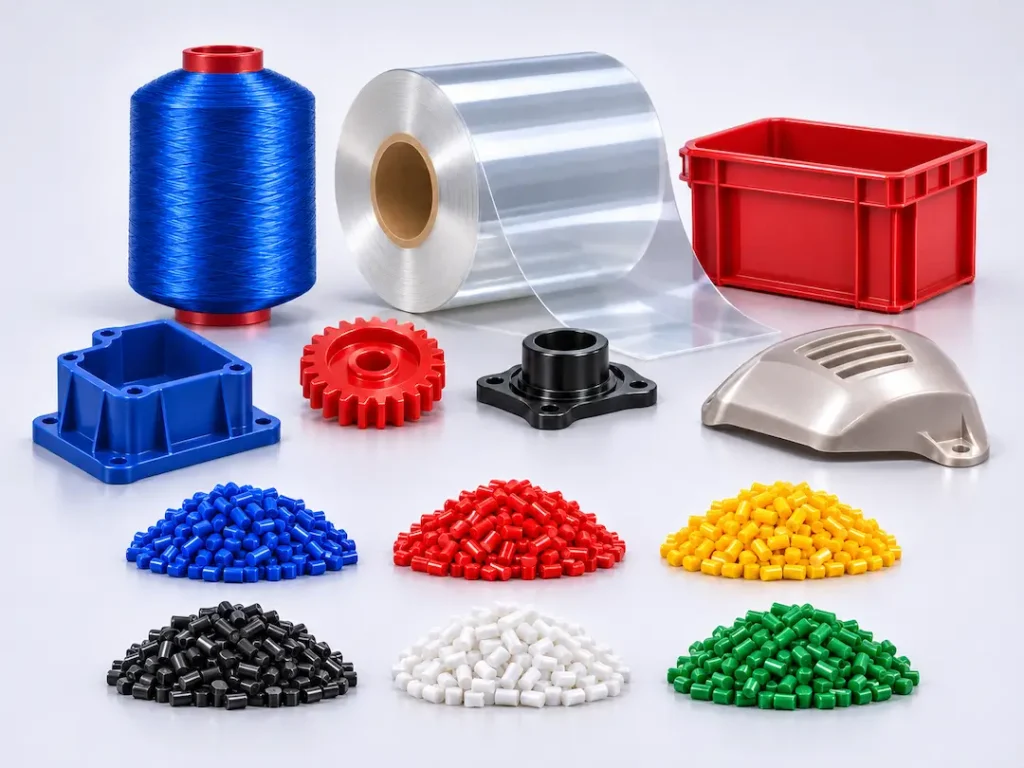
Color is rarely a standalone requirement in industrial plastics and synthetic fibers. Buyers need a precise, repeatable shade that survives processing temperatures, UV exposure and years of service — and increasingly they need that color combined with a functional additive in a single pellet. Able Materials develops custom color masterbatch for PET, PA and a range of engineering and commodity polymers, matched to your reference, validated in your process, and documented per batch. As a China-based masterbatch manufacturer in Suzhou, we handle color development from first lab match through volume production and export.
Every color project is built around three questions: which polymer carries the color, how the color is measured and approved, and whether an additive function must travel with the pigment. The sections below explain how we answer each one.
Color Matching for Industrial Buyers
Accurate color matching is a measurement problem before it is a production problem. We work from your reference and your polymer, not from a generic swatch, so the approved shade reflects the resin, processing method and part geometry you actually use.
Reference systems — Pantone, RAL, physical sample
We match to several reference types and will tell you which gives the most reliable result for your application:
| Reference type | Best used for | Notes |
|---|---|---|
| Physical sample (part, yarn, chip) | Most accurate matches | Preferred — captures gloss, texture and substrate |
| Pantone (PMS) | Brand and design colors | Translated to a resin-specific recipe |
| RAL | Industrial and architectural shades | Common for engineering plastics |
| Spectral / Lab values | Objective, instrument-based matching | Lowest ambiguity when supplied |
A physical sample in the same polymer and finish as your end product remains the most reliable reference, because gloss, translucency and surface texture all shift perceived color.
Lightfastness and color-fastness considerations by polymer
Pigment selection depends on the carrier polymer and the service environment. A shade that performs well in an indoor injection-molded part may fade in an outdoor textile. For fiber and outdoor applications we specify higher-performance pigments with appropriate lightfastness ratings, and for synthetic fibers we also consider wash and rub color fastness. The right pigment package is chosen per project, with relevant test references agreed before production.
Batch-to-batch color consistency
Repeatable color across production runs is controlled through fixed pigment recipes, consistent let-down ratios and spectrophotometer checks against the approved standard. Each production batch is measured and released against the signed-off reference so repeat orders stay within an agreed tolerance (ΔE) rather than drifting over time.
Product Formats
Color can be delivered in several physical formats. The right choice depends on your dosing equipment, processing method and the level of effect or function you need.
Solid pellet color masterbatch
Pellet color masterbatch is the standard format for most extrusion, injection-molding and fiber-spinning lines. It meters cleanly, stores well and disperses reliably at a controlled addition ratio. Carrier resin is matched to your base polymer to protect dispersion and avoid compatibility problems.
Liquid color concentrate for synthetic fibers and plastics
Liquid color concentrate suits applications that need very low addition rates, fast color changes or fine dispersion — particularly in synthetic fiber spinning. Because it disperses without a melt-blending step, liquid color can reduce changeover time and pigment waste where equipment is set up to dose it.
Special-effect masterbatch (metallic, pearlescent, fluorescent)
Special-effect masterbatch carries metallic, pearlescent and fluorescent pigments for products that need a visual effect beyond solid color. Effect pigments are orientation- and dispersion-sensitive, so these grades are developed with the processing method in mind and validated on representative parts or yarn before scale-up.
Color and additive combination masterbatch (color + UV / FR / antistatic)
A combination masterbatch delivers color and a functional additive in one pellet — for example color plus UV stabilization for outdoor textiles, color plus flame retardance for interior parts, or color plus antistatic for technical applications. Combining both in a single masterbatch simplifies dosing and improves consistency compared with adding two separate concentrates. Function and color are balanced together, because a heavy additive load can shift the final shade. Where a regulated functional claim is involved, scope and testing are confirmed per SKU. See our functional masterbatch capabilities for the additive side of these combinations.
Supported Carrier Polymers
Carrier compatibility determines dispersion quality, so the masterbatch carrier is selected to match your base resin rather than forced into a universal carrier.
PET, PA6, PA66, PP, PE, ABS, PC, PBT
We develop color masterbatch across the common industrial polymers:
- PET — fiber and film grades (for PET-specific color and functional grades, see PET masterbatch)
- PA6 and PA66 — nylon fiber and engineering parts
- PP and PE — packaging, molded and extruded products
- ABS, PC, PBT — engineering and technical components
Our deepest capability is in PET and PA color for fibers and films, which is where high color fastness and process stability matter most.
Engineering and specialty polymers on project review
Specialty and higher-temperature polymers, or unusual resin blends, are handled on project review. Share the resin grade, processing window and target application and we will confirm feasibility before committing to a sample.
Development Workflow
A custom color moves through a defined sequence from reference to released production, so approval criteria are clear at each step. This mirrors our broader custom masterbatch development process.
Color submission and lab matching
You submit the reference (physical sample, Pantone/RAL code or spectral values) along with the carrier polymer and processing details. Our lab builds a candidate recipe and measures it against your standard.
Prototype pellet and test article
We produce a prototype pellet and, where useful, a test article — a molded chip or a short spun sample — so you can evaluate color in the real polymer and finish rather than on paper.
Color approval, production and QC
Once you approve the matched sample, that reading becomes the production standard. Every batch is checked against it and released with a certificate of analysis. Documentation and in-process checks are covered in detail on our quality control and documentation page.
Standard color library vs fully custom color
If your requirement is close to a common shade, a standard color can shorten lead time and reduce sampling. A fully custom color is developed from your reference when an exact brand match or a specific performance target is required. We will advise which route fits your tolerance and timeline.
Typical order stages for a color project run from a 5–25 kg lab sample, to a 100–500 kg trial order, up to production — where the MOQ is typically 500–1,000 kg depending on carrier resin and formulation.
FAQ
What is custom color masterbatch used for?
It is a concentrated pigment carrier added to a base polymer during processing to color plastics and synthetic fibers at a controlled ratio, giving consistent shade without handling raw pigment on the production line.
How is color matched to my sample?
We match from a physical sample, a Pantone or RAL code, or spectral (Lab) values. A physical part in your own polymer and finish gives the most accurate result because gloss and texture affect perceived color.
What is the difference between color masterbatch and liquid color?
Pellet color masterbatch is a solid concentrate that meters on most standard lines; liquid color is a dispersion that enables very low dosing and fast color changes, and is common in fiber spinning. The best format depends on your equipment.
Can color and a functional additive be combined in one masterbatch?
Yes. A combination masterbatch carries color plus a function such as UV stabilization, flame retardance or antistatic in a single pellet, which simplifies dosing. Color and additive loads are balanced together, and any regulated claim is scoped per SKU.
What is the minimum order for custom color?
Lab samples run 5–25 kg and trial orders 100–500 kg. Production MOQ is typically 500–1,000 kg depending on the carrier resin and formulation complexity.
How is batch-to-batch consistency controlled?
Each batch is measured on a spectrophotometer against the approved standard and released within an agreed color tolerance (ΔE), using fixed recipes and controlled let-down ratios.
Request Custom Color Development
Send your color reference (physical sample, Pantone/RAL code or spectral values), the carrier polymer and grade, your processing method, addition ratio target, any functional or fastness requirement, and the volume you expect. Our team will confirm feasibility, propose a recipe and prepare a lab sample for approval. Contact Able Materials to start a custom color masterbatch project, or browse the full masterbatch product range.