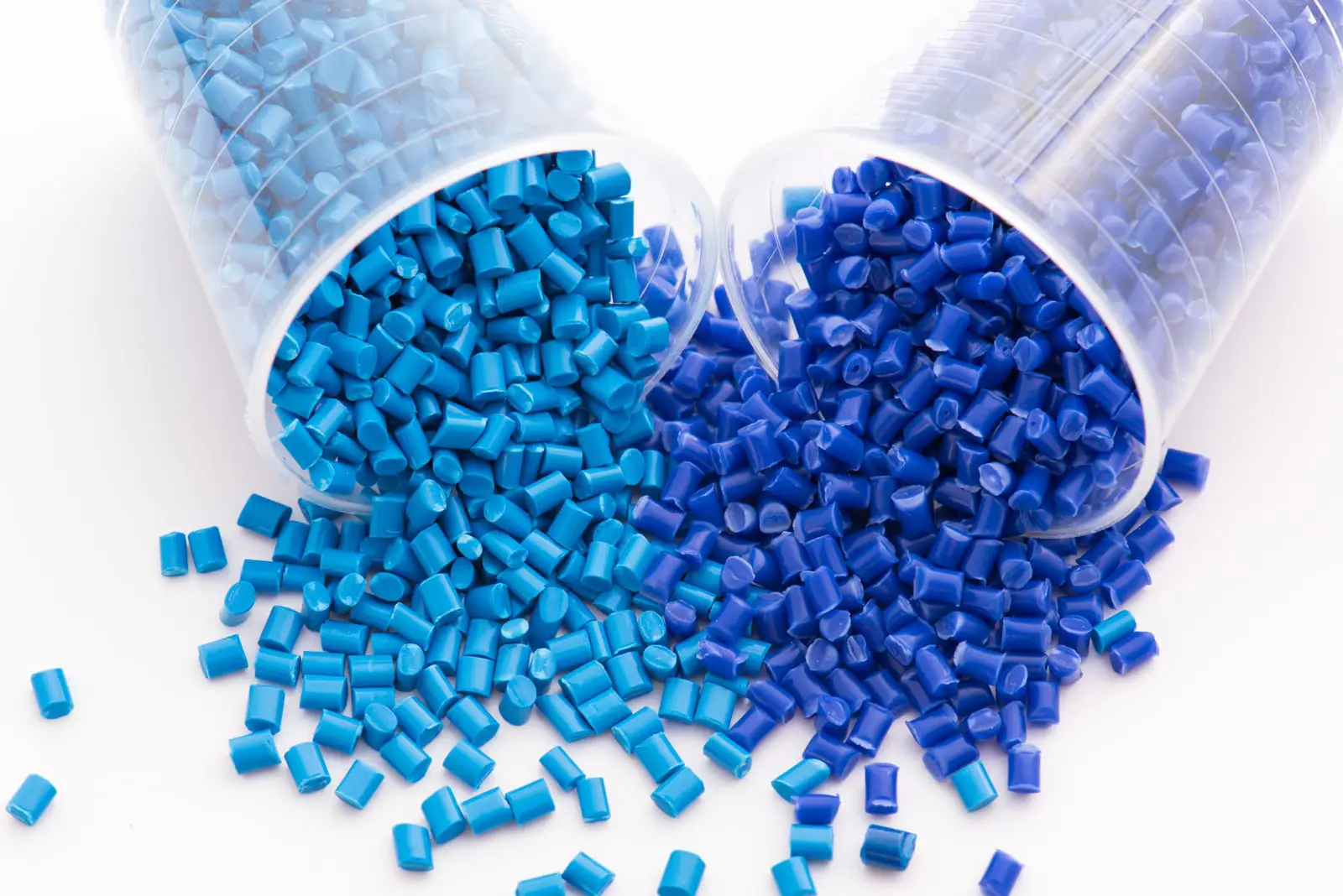
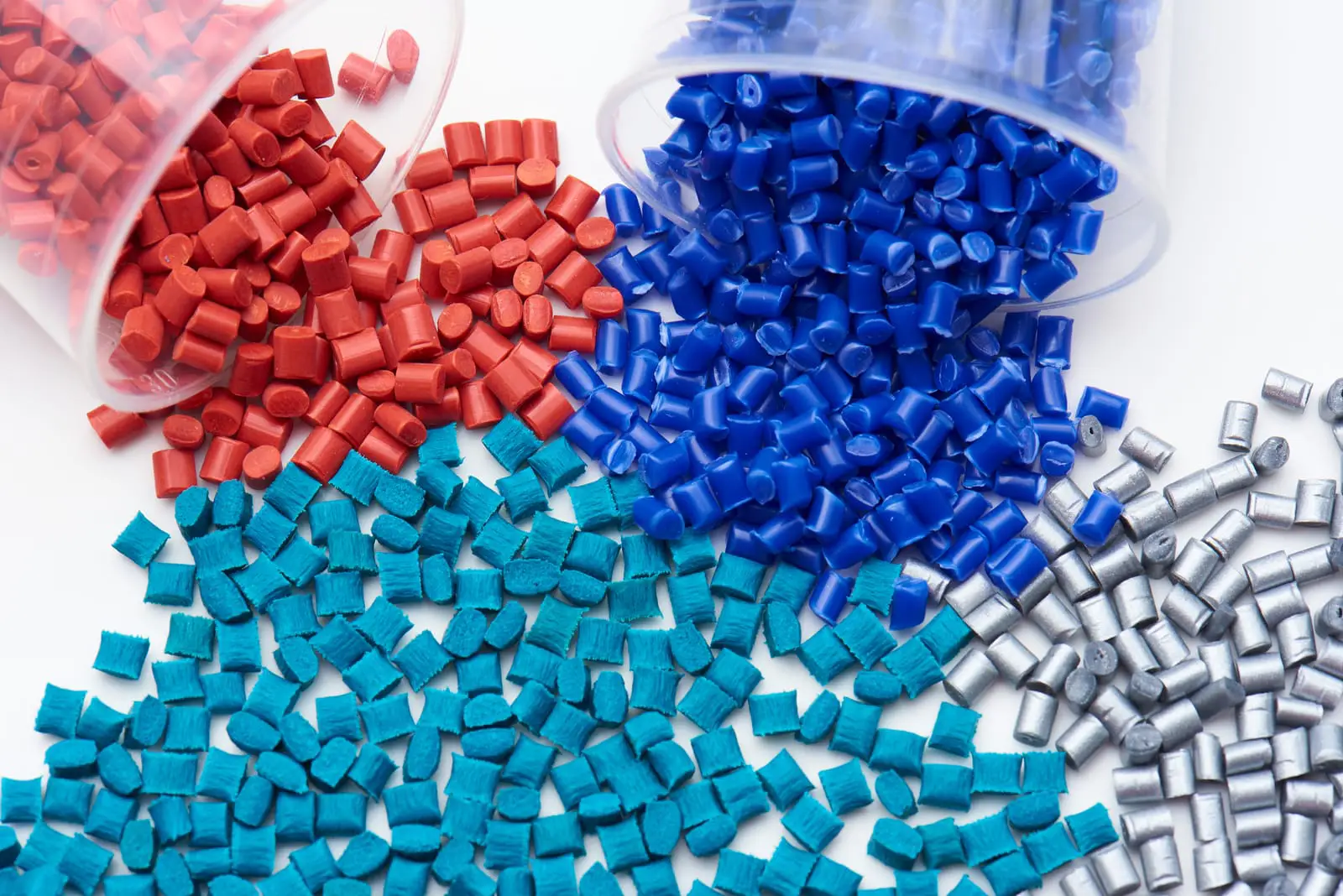
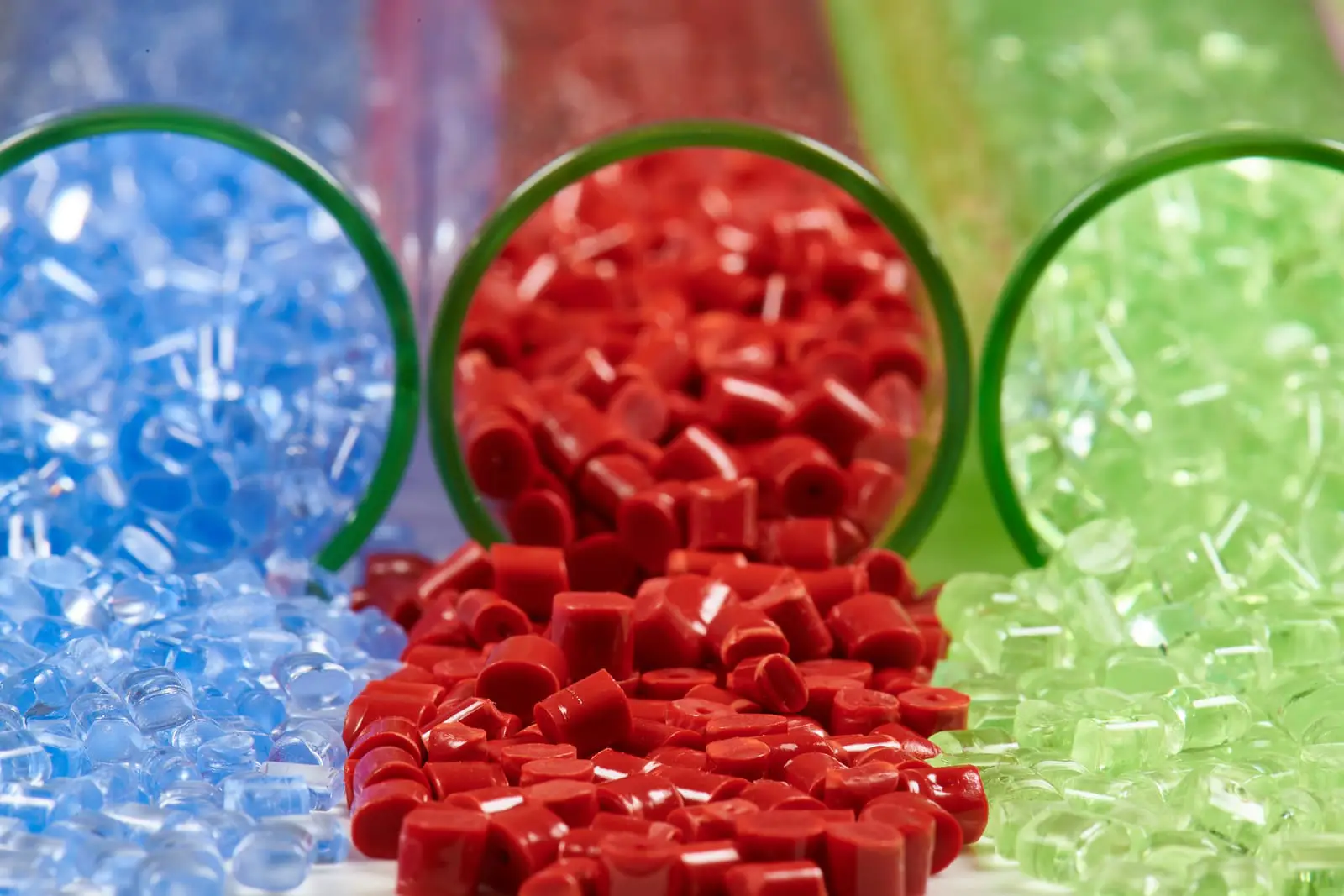
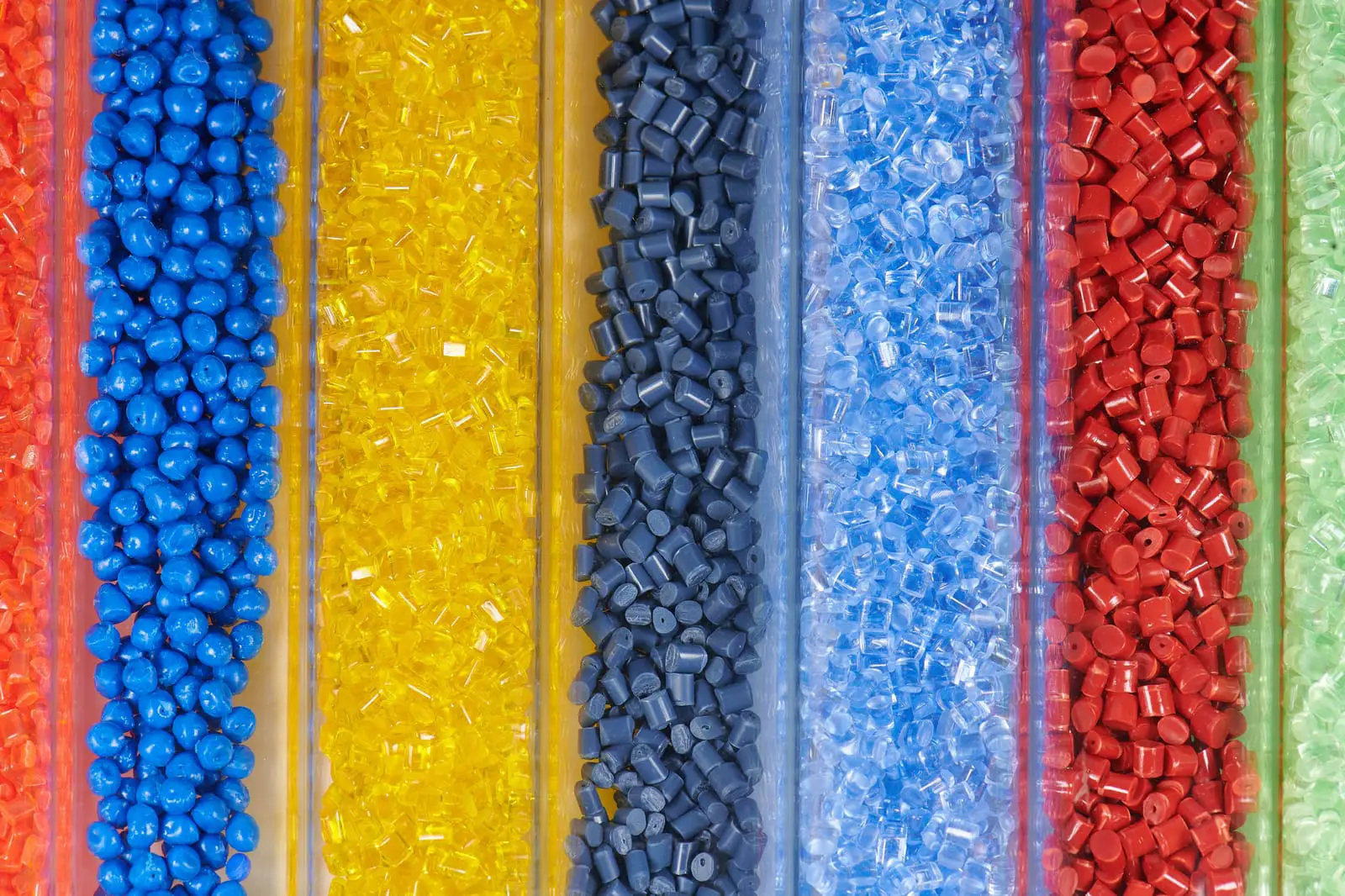
Dope-dyed fiber masterbatch is a pigment concentrate metered into the polymer melt during spinning, so the filament is colored before it exists as a fiber. Able Materials is a dope-dyed fiber masterbatch manufacturer in China, producing spinning-grade color for polyester, nylon and other synthetic fibers. The product range sits within our fiber masterbatch range, and each shade is matched to the buyer’s line, polymer and fastness requirement.
How Dope Dyeing Colors Fiber at the Spinning Stage
Where color masterbatch is dosed in melt spinning
On a chip-fed line, masterbatch pellets are blended with natural chip at the extruder hopper through a feeder. On direct-spinning lines, a side-stream unit meters color into the melt before the spin pack. In both cases the let-down ratio must stay steady, because dosing drift shows up as shade variation along the yarn.
Color through the full filament cross-section
The pigment sits inside the polymer, not on its surface. A cut filament shows the same shade at the core as at the edge, so abrasion, laundering and sunlight do not expose an undyed layer. This is why solution-dyed yarn is specified for upholstery, carpet and outdoor fabric.
When dope dyeing makes sense vs dyeing after spinning
Dope dyeing fits stable, repeat colors and larger lots, where color is fixed once at spinning and each change costs a line purge. Piece dyeing fits short runs, many colors and late color decisions. For a fuller comparison, read our guide to dope dyeing vs piece dyeing.
Color Performance Targets for Dope-Dyed Fiber
Targets are written into the specification before sampling and tested on fiber or fabric, not on pellets.
Lightfastness and weathering
Lightfastness is rated against ISO 105-B02 (xenon arc) or AATCC 16.3. Automotive and outdoor programs often add accelerated weathering to their own OEM or customer method. Pigment choice drives the result: inorganic and high-performance organic pigments hold up under UV far better than economy organic grades. Outdoor applications are covered on our outdoor textiles page.
Wash, rub and sublimation fastness
Common test references are ISO 105-C06 for washing and ISO 105-X12 for rubbing. For polyester, sublimation fastness (ISO 105-P01 dry heat) matters when the fabric later meets heat setting, transfer printing or hot storage. Pigments that migrate under heat are screened out during formulation.
Shade consistency across lots and spinning positions
Buyers usually set a color-difference limit (ΔE) against an approved standard, measured on a spectrophotometer. Shade also depends on the line, so the approved reference is yarn spun on the buyer’s own equipment, not a lab plaque.
Pigment Selection for Spinning-Grade Color
Heat stability at spinning temperatures
PET melts are processed at roughly 280–295 °C, and PA66 at similar levels, while PA6 runs lower. Pigments are chosen to stay stable through residence time in the extruder and spin pack, with no darkening, dulling or shade drift. Many standard plastic pigments are not suitable and are excluded at the start.
Pigment particle size, dispersion and filter life
Poorly dispersed pigment blocks spin-pack filters, raises pack pressure and causes filament breaks. Maximum filter pressure value (FPV) limits can be written into the purchase specification.
Fine-denier and microfiber considerations
As filaments get thinner, pigment agglomerates become large relative to the filament diameter. Microfiber and low-denier yarn need tighter dispersion control, lower pigment loading where the shade allows, and a trial on the real filament count.
Fibers and Yarn Formats Supported
Polyester filament (POY, FDY, DTY) and staple fiber
Color is added at the spinning stage for POY and FDY. DTY is textured from POY, so DTY color is set by the POY it is drawn from. Polyester staple fiber for spun yarn and nonwoven uses the same approach. For polymer-level detail, see our polyester fiber masterbatch and PET masterbatch pages.
Nylon BCF carpet yarn and textile filament
PA6 and PA66 grades are made for BCF carpet yarn, industrial yarn and textile filament. The carrier is matched to the nylon grade, because melt temperature and moisture behavior differ between PA6 and PA66.
Other synthetic fibers on project review
PBT, polypropylene and other fiber polymers are reviewed case by case. Send the resin grade and spinning method, and we confirm whether a suitable carrier and pigment system can be developed.
Color Matching for Dope-Dyed Projects
Submitting yarn, fabric or Pantone/RAL references
Accepted references are physical yarn or fabric, Pantone or RAL codes, and a color-difference tolerance. A physical sample is the most reliable, and a code should come with the polymer, denier and fabric construction. Matching method detail is on our custom color matching page.
Lab spinning trials and shade approval
A lab sample is checked for color, dispersion and melt behavior, then spun on a pilot line or the buyer’s line. The buyer approves the shade on spun yarn or knitted fabric. Once approved, the formulation is locked as the production reference.
Standard shades, custom shades, deep black and white
Standard shades shorten lead time, and custom shades are matched to a reference. Deep black uses finely dispersed carbon black for jetness without filter clogging. White uses titanium dioxide, and high loadings need careful dispersion to protect filament strength.
How Dope-Dyed Fiber Masterbatch Is Manufactured
Formulation and raw material selection
The carrier is PET or PA, chosen to match the fiber polymer’s melt flow. Pigments are then selected for heat stability at the buyer’s spinning temperature and for the fastness targets in the specification. PET and PA carriers are dried before compounding.
Compounding and dispersion for spinning-grade color
Pigment and carrier are melt-compounded on a twin-screw extruder. Screw design, feed sequence and melt filtration are set to break up agglomerates, because pigment particles must stay small relative to the filament diameter. This is the most important control in dope-dyed masterbatch.
In-process testing before release
Each batch is checked against the approved standard for color difference (ΔE), filter pressure value (FPV), melt flow and moisture. Batches outside the agreed limits are held back or reworked.
Packaging and batch traceability
Masterbatch is packed in moisture-protective bags and labeled with grade and batch number. The batch record links to the COA, and a reference sample is retained so a yarn issue can be traced to its lot.
Order Stages and Documentation
Lab sample, trial order and production quantities
Projects run in three stages: a lab sample of a few kilograms, a trial order typically from 100 kg, and then production quantities. Production MOQ depends on the carrier resin and the color. Sampling and development are handled at our Suzhou base.
TDS, SDS, COA and fastness test reports
- TDS: carrier, recommended let-down ratio, processing window and storage guidance
- SDS: hazard and handling information for import
- COA per batch: color difference, moisture, melt flow and dispersion or FPV results
- Fastness reports: light, wash, rub and sublimation results for the tested construction
Further checks are described on our quality control page.
FAQ
What percentage of masterbatch is used in dope dyeing?
Most color grades are dosed at about 1–5% by weight. Pale shades use less, and deep black or saturated shades use more. Some functional and white grades run outside this range. The final ratio is fixed in a spinning trial.
Does color masterbatch need drying before spinning?
Yes, for polyester and nylon. Both absorb moisture, and wet masterbatch causes viscosity loss, bubbles and filament breaks. Dry it with the base chip, to the same moisture target, unless the grade is supplied pre-dried in sealed packaging.
Can dope-dyed polyester be recycled?
Yes. Dope-dyed polyester is a single polymer with the pigment inside it, so it can enter mechanical recycling. The recycled material keeps some color, which limits it to similar or darker shades.
Why can a dope-dyed shade look different from a dyed reference?
Dyes and pigments reflect light differently, and the substrate affects the result. A shade can match under one light and drift under another (metamerism). Matching on spun yarn, checked under several light sources, reduces the risk.
Can dope-dyed fiber be over-dyed afterward?
Not reliably. The pigment stays inside the fiber, so a later dye bath adds little and may produce uneven color. If a program needs both routes, plan the base color at spinning and avoid relying on later dyeing.
Request a Dope-Dyed Fiber Masterbatch Quote
Send the following details for a dope-dyed fiber masterbatch quotation:
- Fiber polymer and grade (PET, PA6, PA66 or other), including any recycled content
- Spinning process, denier and filament count
- Color reference (physical sample, Pantone or RAL) and ΔE tolerance
- Fastness standards and pass levels
- Trial quantity and expected annual volume
- Destination country and required documents