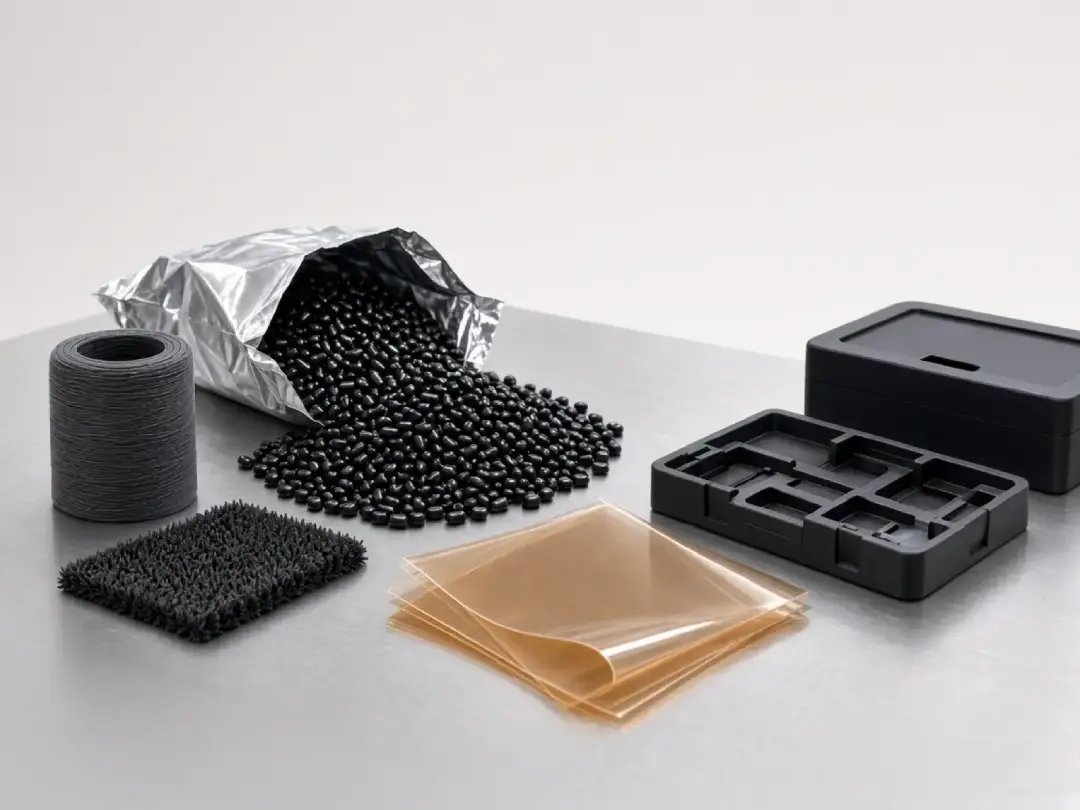
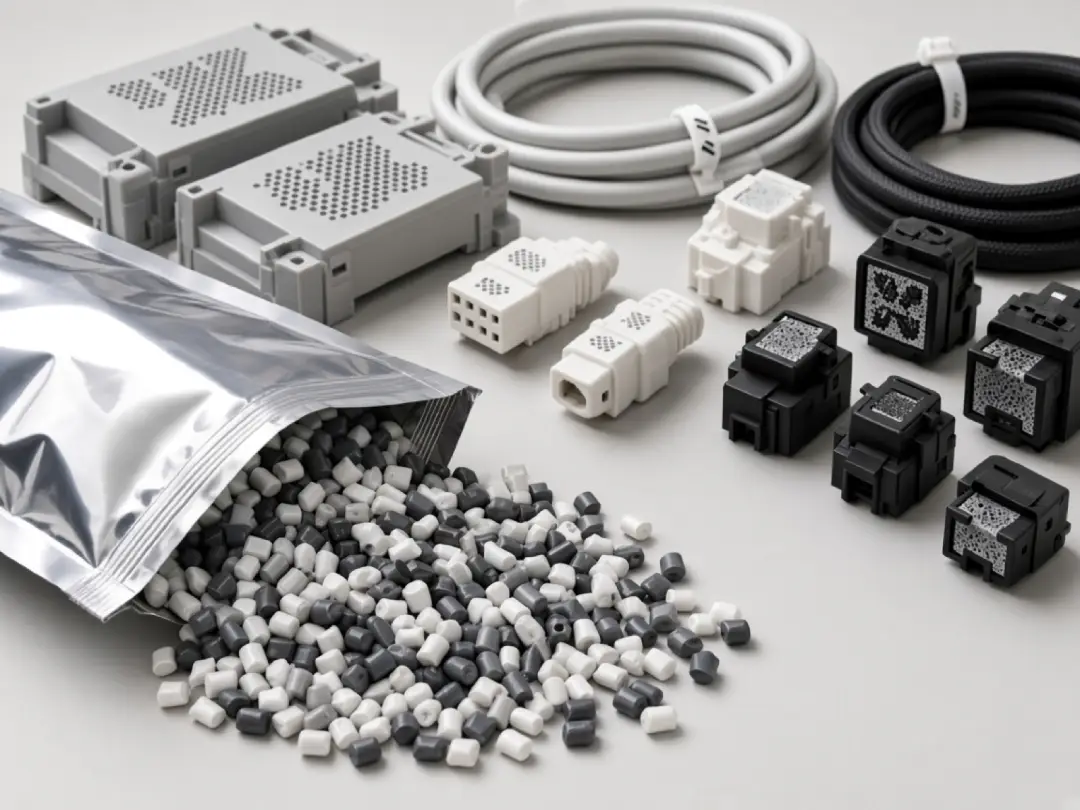
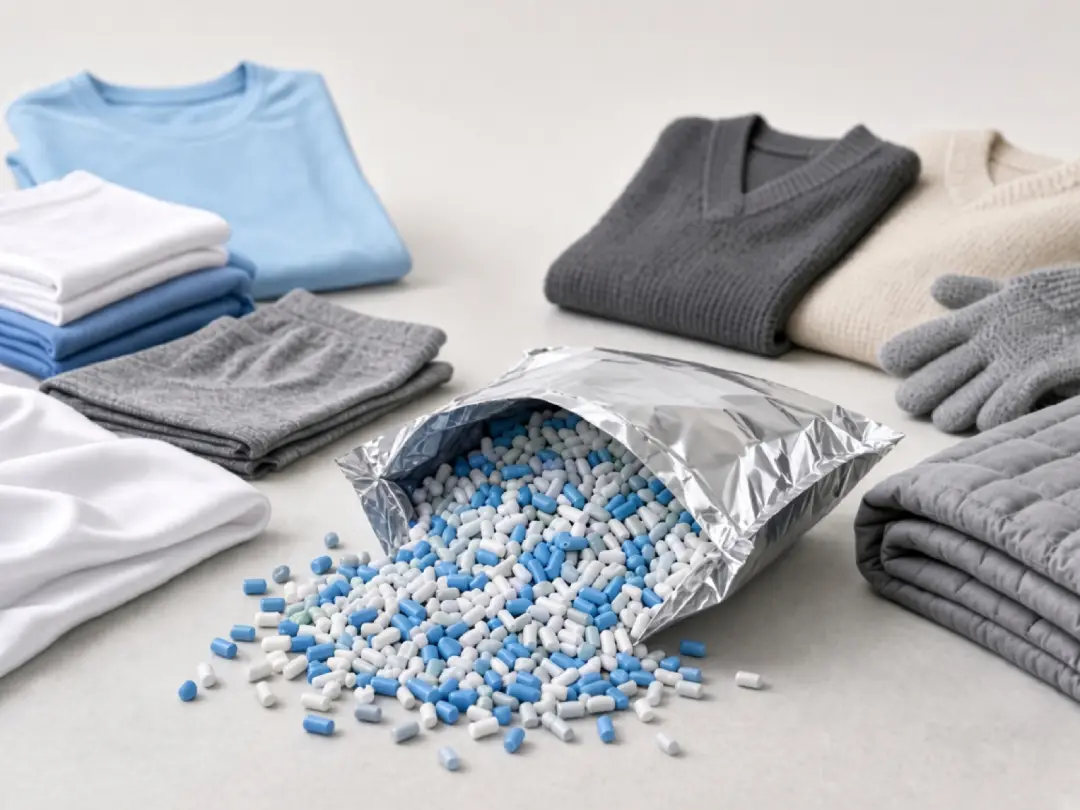
Antistatic and conductive masterbatch gives a plastic part, film or fiber a controlled path for electrical charge, so static does not build up or discharge uncontrolled. As an antistatic and conductive masterbatch manufacturer in China, Able Materials develops grades that are matched to a resistivity target, a carrier polymer and a processing route. The range sits within our functional masterbatch offering and covers yarn, film and molded parts.
Antistatic vs Conductive — Choosing by Resistivity Target
Static-dissipative and conductive ranges
Antistatic, static-dissipative and conductive describe different resistivity bands. The boundaries vary between standards, so the target is confirmed with the buyer at the start.
| Class | Typical surface resistivity | Typical use |
|---|---|---|
| Antistatic | about 10⁹–10¹² Ω/sq | Packaging film, dust control, general goods |
| Static-dissipative | about 10⁵–10⁹ Ω/sq | Electronics packaging, handling trays |
| Conductive | below about 10⁵ Ω/sq | ESD-protective parts, conductive filaments |
Untreated PE, PP, PET and PA are highly insulating, usually above 10¹⁴ Ω/sq.
Surface vs volume resistivity
Surface resistivity describes how easily charge moves across the surface of a part. Volume resistivity describes how easily it moves through the thickness. Film and packaging specifications usually quote surface resistivity. Molded parts and compounds are often specified by volume resistivity as well. The specification states which one applies, and the grade is developed against that value.
Antistatic Masterbatch
Migrating antistatic agents and humidity dependence
Migrating agents, such as ethoxylated amines and glycerol esters, move slowly to the polymer surface. There they attract a thin layer of moisture from the air, and that layer lets charge leak away. They work at low loading and suit PE and PP film, bags and general packaging.
Their performance depends on ambient humidity. It also needs time to develop after production, and it can be reduced by wiping, washing or long storage. For fiber, many migrating agents are not thermally suited to PET or PA spinning and may be lost during washing, so they are reviewed carefully for that use.
Permanent antistatic systems
Permanent systems use an inherently dissipative polymer that forms a network inside the carrier polymer instead of a surface layer. They work from the moment the part is made, do not wipe off, and depend less on humidity. The trade-offs are a higher loading and higher cost than migrating agents. These grades suit electronics packaging, cleanroom items and parts with a long service life, and they can be developed in clear or colored versions on project review.
Conductive Masterbatch
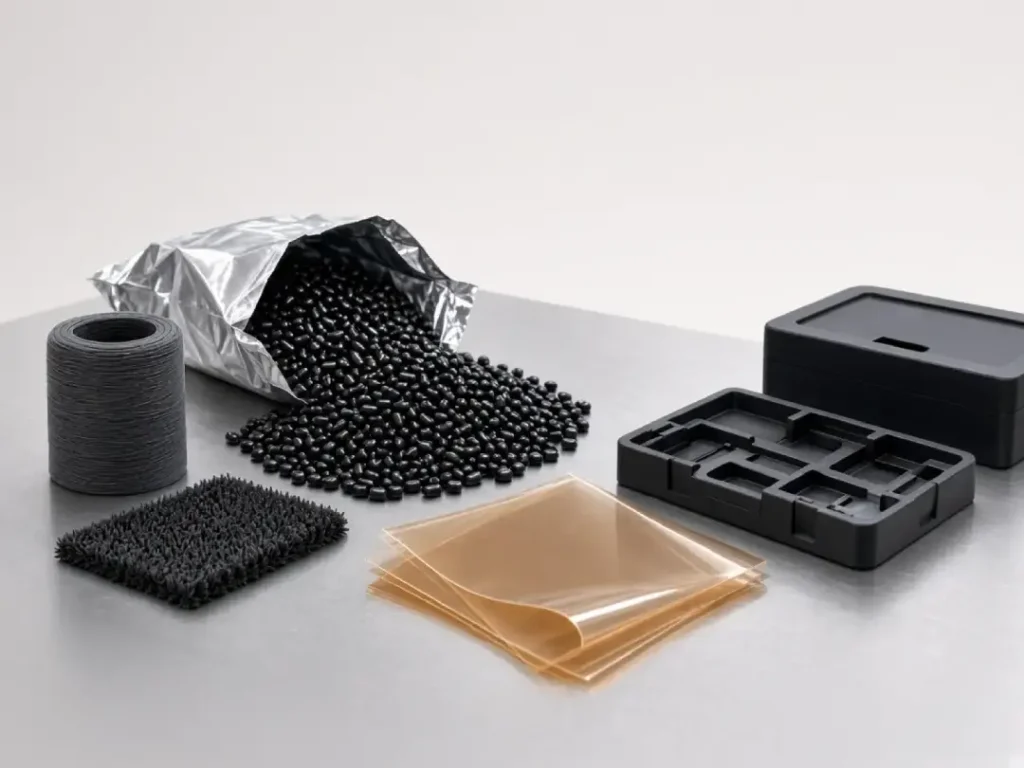
Conductive carbon black and carbon-based systems
Conductive carbon black is the most common route to a conductive masterbatch. Conductivity appears only when the particles form a continuous network through the polymer. Below that point, resistivity stays high. Above it, resistivity drops quickly. This is called the percolation threshold, and it depends on the carbon black structure, the carrier polymer and the dispersion.
High-structure conductive blacks reach the network at lower loading than standard pigment blacks. Carbon nanotubes and other carbon-based fillers are reviewed per project when a part needs lower loading or tighter property control.
Effect on color — dark shades only
Carbon-based conductive grades are black or very dark grey. A light or bright color cannot be produced with them. Where color is required, a permanent antistatic or dissipative grade is the usual alternative. Buyers who need a colored part with static control can discuss it with us under custom color masterbatch.
Mechanical and processing trade-offs at high loading
Conductive loading is far higher than pigment loading, and it brings consequences:
- Melt viscosity rises and melt flow falls, which changes injection and spinning behavior.
- Impact strength and elongation can drop in molded parts.
- High shear can break the carbon network and raise resistivity, so screw design and molding settings matter.
- Surface finish can be affected at high loading.
For these reasons, we aim for the lowest loading that holds the resistivity target, and the result is confirmed on the buyer’s process.
Fibers, Films and Molded Parts
Antistatic and conductive yarns
Conductive yarn is usually made as a bicomponent filament, where a carbon-loaded component takes a small part of the cross-section. The yarn is then blended in small proportion into carpet, workwear and filter fabrics. Antistatic yarn can use a permanent antistatic system in the filament itself. Nylon-specific grades are described on our nylon fiber masterbatch page.
Antistatic film and packaging
PE and PP film for bags, liners and wrapping uses antistatic masterbatch to reduce dust pickup, film cling and static-related line stoppages. Electronics bags and sheet that need a lower resistivity use dissipative or conductive grades. The carrier is matched to the film resin so that clarity, sealing and slip are still within range.
Electronics trays and housings
Injection-molded and thermoformed trays, tote boxes and housings use conductive or dissipative grades to protect sensitive components. Engineering parts in nylon are covered on our PA masterbatch page, and wider sector context is on the electrical and electronics page. Parts that also need ink-free codes can look at our laser marking masterbatch.
How Antistatic and Conductive Masterbatch Is Manufactured
Formulation and raw material selection
The carrier is matched to the end polymer, such as PE or PP for film, PET or PA for fiber, and PA, PP or other resins for molded parts. The additive is chosen by target resistivity. Conductive grades use a carbon black selected for structure and purity. Antistatic grades use a migrating or permanent system selected for thermal stability at the processing temperature and for the destination market. Hygroscopic carriers and carbon black are dried before compounding.
Compounding and dispersion of antistatic and conductive additives
The additive is melt-compounded into the carrier on a twin-screw extruder. For conductive grades, the main controls are uniform dispersion at high loading and protection of the carbon network, so screw design and shear are set to wet out the carbon without breaking its structure. For antistatic grades, melt temperature and residence time are managed so the additive is not degraded.
In-process testing before release
Each batch is checked against the approved reference for melt flow, moisture and, for fiber grades, filter pressure value (FPV). Resistivity is checked on a molded plaque, pressed film or extruded strand against the reference where the grade allows. Where a suitable method exists, carbon or additive content is also checked, for example by ash or thermogravimetric analysis. Final resistivity on the buyer’s part is confirmed in a trial.
Packaging and batch traceability
Masterbatch is packed in moisture-protective bags and labeled with grade and batch number. The batch record is tied to the COA, and a reference sample is retained for traceability. Batch checks are described on our quality control page.
Testing Electrical Performance
Resistivity test methods (IEC 62631-3 series, ASTM D257)
Volume and surface resistivity of plastics are commonly measured under the IEC 62631-3 series or ASTM D257. These methods suit plaques, film and molded samples. For moderately conductive materials, a four-point method may be used instead. Textile protective-clothing tests, such as the EN 1149 series, are run on fabric, not on masterbatch. The method, electrode type, test voltage and pass level are agreed before sampling.
Conditioning and humidity effects on results
Humidity changes results, especially for migrating antistatic grades. A sample that passes at moderate humidity may fail when the air is dry. For this reason, samples are conditioned at the humidity the product will meet, and low-humidity conditioning is used where the specification requires it. Time since production is also recorded, because migrating systems keep developing for a period.
FAQ
Does conductive or antistatic masterbatch make a part ESD-safe?
Not by itself. ESD protection is judged on the finished part, and often on the whole handling program, against the standard the customer applies, such as the ANSI/ESD S20.20 or IEC 61340-5-1 programs. The masterbatch supplies the material property. The part test confirms the result.
What is the difference between carbon black masterbatch and conductive carbon black masterbatch?
Standard black masterbatch uses a pigment-grade carbon black chosen for color strength and jetness, and it usually does not make a plastic conductive at normal loading. Conductive grades use a high-structure carbon black at a much higher loading to form a network, so the electrical result is the design target.
How long does antistatic masterbatch take to work?
Migrating antistatic agents need time to reach the surface, often from several hours to a few days, depending on the polymer, additive and temperature. Permanent systems work as soon as the part is made. Testing should start after the migration period agreed in the specification.
Can antistatic masterbatch be used in food-contact packaging?
It depends on the additive, the resin, the contact conditions and the destination market. Each grade and each market is reviewed individually, and a food-contact declaration is provided only where the formulation supports it. Regulatory scope is outlined on our compliance page.
How much conductive masterbatch is needed to reach a target resistivity?
There is no fixed percentage. The amount depends on the carbon black, the carrier, the dispersion and the process, and the resistivity changes sharply near the percolation point. The let-down ratio is set in a trial on the buyer’s own equipment and then confirmed on the finished part.
Request an Antistatic or Conductive Masterbatch Quote
Send the following details for an antistatic or conductive masterbatch quotation:
- Base polymer and grade (PE, PP, PET, PA6, PA66 or other), including recycled content
- Process (fiber spinning, film extrusion, injection molding) and part thickness
- Target resistivity (surface or volume), test method and pass level
- Conditioning requirement, including humidity
- Color requirement (black or dark only for carbon-based grades)
- Food-contact, REACH or RoHS requirements, if any
- Trial quantity, expected annual volume and required documents
Our technical team reviews feasibility and proposes a sampling route. Use the contact page to send your specification.